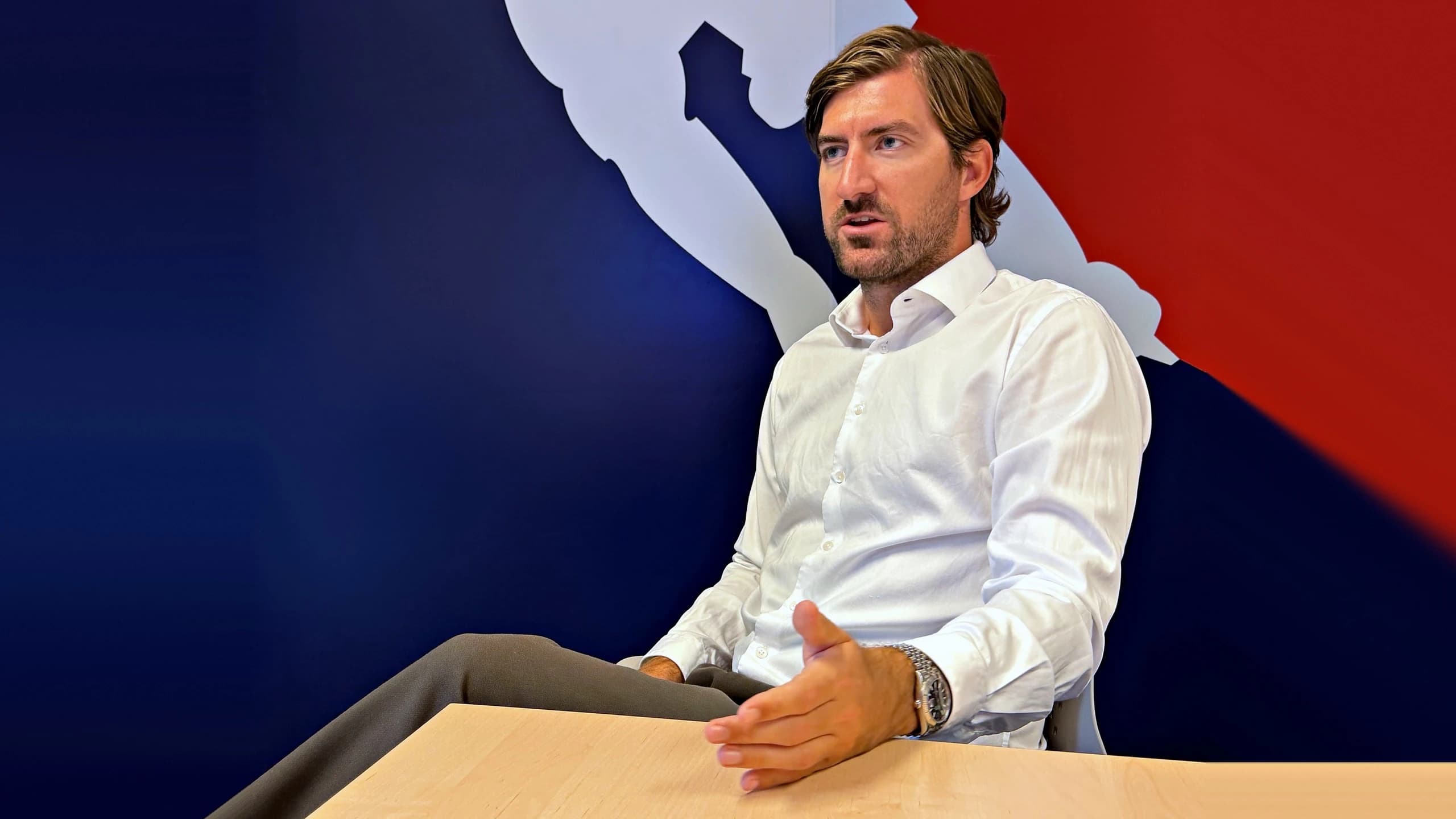
ÖEHV Managing Director Alexander Helwig: "People want ice hockey"
Alexander Helwig has been Managing Director of the Austrian Ice Hockey Federation for a year. In this interview, he takes stock of the financial situation and talks about modern approaches to sponsorship, a new culture of communication and what Austria still needs on its path towards the world's top 10.
6 min read
 ÖEHV
ÖEHVÖEHV: Alexander, you have now been Managing Director of the ÖEHV for a year. How do you assess that period?
Alexander Helwig: My assessment is entirely positive, although I would like to distinguish between two levels. From a sporting perspective, the men's World Championship, with nine points in the group stage, was once again a major success. The women's first World Championship in the top division is still to come, as it was postponed. However, we have also made visible progress in our organisation in this area. Financially, the most important thing for me was that we broke even in 2025.
The break-even result you have already mentioned is your overriding principle. Why is a sound financial foundation so crucial for the federation, and where do we stand today?
A sound financial foundation is essential. This applies not only to the ÖEHV, but to every club in Austria, regardless of the sport. Much of sport is based on voluntary work, but we also have full-time employees. On top of that, there has been enormous inflation: the same programme for our national teams now costs us around 40 per cent more than it did three years ago. We therefore have to continuously increase our revenue simply to maintain our standards, let alone expand them. Our vision is to develop Austrian ice hockey towards the world's top 10 over the long term. Whether it is national team programmes, infrastructure projects or the relaunch of the website, everything costs money. You can take certain risks, but without the necessary capital there can be no further development. That is why it is so crucial for us to at least break even every year and neither incur debt nor reduce our equity.
We have brought new partners into the network. What can we offer them to ensure that the collaboration delivers genuine added value for both sides?
This year alone, we have succeeded in securing between 15 and 20 new partners and significantly increasing revenue. This was possible because we have completely restructured the entire commercial partnerships area. That does not mean everything was bad before. However, sponsorship has evolved: a space on a jersey, helmet or rink boards in return for a fixed sum is no longer enough today. We live in an experience economy. Companies that come on board with us expect genuine added value. That is why we do not prescribe one-size-fits-all solutions, but first want to understand what our partners really need.
What exactly do partners want today?
That varies greatly. Some are looking for contacts in politics, others want to benefit from our network or use us as a recruitment platform to address the shortage of skilled workers. Others still want to bring their product closer to the national teams and fans, or increase their reach on social media. The packages vary accordingly, with each one tailored to the partner. I particularly owe the fact that this works to my outstanding team. Of course, we cannot offer everything, as our national team players are not available to us around the clock. However, when they are with us, they are happy to help develop ice hockey sustainably.
"Earning trust" is one of your leadership principles. What does that mean in concrete terms when dealing with clubs, leagues, regional associations and everyone else in Austrian ice hockey?
I encountered this principle at Amazon, where I had the opportunity to work in many roles across different countries. When taking on a new leadership position, the most important thing for me is to build trust with everyone involved. This applies just as much to the team at the federation office as it does to the clubs, from the ICE Hockey League down to the lower divisions, in men's, women's and para ice hockey, as well as to the regional associations. For me, this can only be achieved through complete openness and transparency. In the past, there was sometimes criticism that the ÖEHV sat in its ivory tower in Vienna, far removed from the grassroots.
How do you want to change that?
By actively seeking dialogue and working together to identify the opportunities and risks in Austrian ice hockey. Because the ÖEHV is all of us, all of its members. There are different problems in the east than in the south or west – infrastructure being a case in point. Nevertheless, there needs to be an overarching strategy that, ideally, everyone supports. That can only work through regular exchange and openness to feedback.
You wanted to change the culture of communication, both internally and externally. What have you initiated to achieve that, and where is it already noticeable?
Internally, it was primarily about processes. We had to adjust several areas in our operational work, and we will continue to do so. What matters to me is how we speak to and treat one another: with appreciation, openness and transparency. Mistakes can happen every day. However, the feedback from within and outside the organisation shows that we are on a very good path.
What has changed specifically at the federation office?
The personnel changes are most visible from the outside. Two long-serving team members have left us. I am very grateful to them for everything they have achieved. In return, we have recruited three new team members and redistributed responsibilities internally, making us more efficient. In external communications, we have increased the media team’s capacity from around 20 to at least 70 hours per week. More time does not automatically mean better. However, it provides more opportunities to cover topics and training camps. We were no longer entirely up to date in this area. We used to work with an external social media agency; now we handle it ourselves. This is complemented by a new social media presence and the previously mentioned rebranding of the website. The feedback has been very positive so far. We want to continue along this path.
Your goal is to make ice hockey the clear number two among team sports in Austria. What are we still lacking to achieve that?
It feels as though we are not far away at all, roughly on a par with handball. In terms of attendances, ice hockey is already clearly number two behind football. So, one could say that the goal is not ambitious enough. This brings us back to the top 10 in the ice hockey world.
That is the long-term destination. What is needed to get there, and how realistic is this goal?
Top 10 does not just mean reaching a quarter-final every two years – for both men and women. The necessary conditions must be in place throughout Austria: financial resources, infrastructure, youth development and a clear commitment. We need sufficient ice rinks to carry out youth development work in the long term. Financial incentives are a huge lever: clubs that do good youth development work should be rewarded for it, while all others should be given a reason to follow their example. That is precisely the aim of the Training Compensation System (AKES), which we operationally launched in my first year.
The new Federal Performance Centre in Villach is also an important building block on the way there.
Exactly, the Federal Performance Centre for women’s ice hockey in Villach will open on 16th November. As our President Klaus Hartmann has already said: this is a flagship project unlike anything else in Europe. Above all, it will provide a further boost to women’s ice hockey – but, with an additional ice rink, also to ice hockey as a whole.
What role does politics play on this journey?
Politics plays a major role. The question must be: is ice hockey a sport that we want to support in Austria and bring to the top of the world? I am clearly in favour – and the successes of our senior national teams are strong arguments. However, it also requires a conscious decision by politicians – and ultimately, we all elect them. In any case, attendance figures show that people want ice hockey. Austria is a winter sports country, and ice hockey is the number one team sport in winter. Skiing will change as a result of the climate crisis. I am an enthusiastic skier myself, but a day of skiing is a major investment for families. Indoor ice skating is cheaper and easier. So we have fertile ground; now we need to plant and water it.