City Park Open Ice Rink in Budapest a resounding success
Last Saturday, the Hungarian federation invited around 1.000 children to the City Park Open Ice Rink. Para ice hockey was also showcased as part of the event – to great success.
1 min read

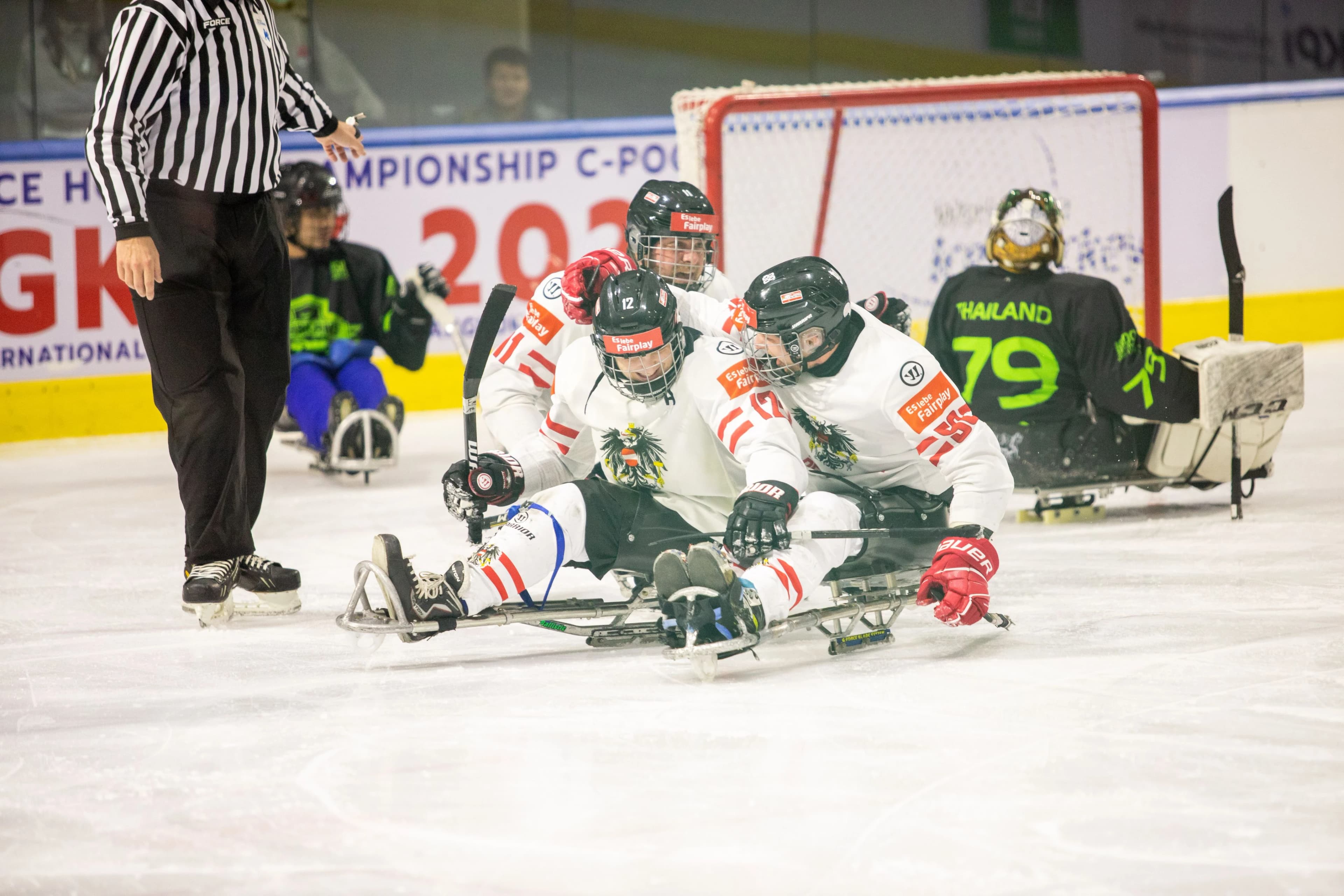
“A really cool event,” enthused Para head coach Lucas Herrnegger after the event. Around 1.000 children gathered on the huge ice surface, where a small rink was also available to Herrnegger, Timo Ropp and Libor Fischer to showcase their sport.
Incidentally, Timo Ropp made a small piece of history as the first Austrian Para Hockey player on Hungarian ice. The national team player and his two colleagues provided support and showed what Para ice hockey is all about. The Hungarian federation provided around six sledges and sticks for the occasion. Libor Fischer helped interested participants into the sledges and gave them initial instructions and information.
More than ten people with disabilities took to the sledges during the two-hour presentation. “It was fantastic and superbly organised. The City Park Open Ice Rink provided an excellent opportunity to promote the Para ice hockey project in advance,” said Libor Fischer, delighted with the success of the event.
“We hope for good and intensive cooperation with the Hungarian federation and offer our assistance in developing Hungarian Para ice hockey. We want to remain in regular contact and play friendly matches or hold joint training sessions in future,” continued Libor Fischer.
Facts and figures on the City Park Open Ice Rink:
- 1.100 children from the U8 and U10 age groups competed in a tournament on Saturday
- With an ice surface of more than 12.000 m², it is the largest and second-oldest artificial ice rink in Europe. It regularly hosts figure skating, ice hockey and speed skating championships.
- A vast marsh still occupied the site of today’s City Park Lake in the 18th century, and it was not drained until the end of the century by Rudolf Witsch. The lake and park created there (City Park) developed into a local recreation area and excursion destination for the city’s residents. As early as the 1830s, the lake, which froze over in winter, became increasingly popular as a place for ice skating.